Basic Petrophysics · Module B6
Net Pay Construction
How net reservoir and net pay are built from porosity, shale-volume and saturation cut-offs, why net-to-gross carries the same leverage on STOIIP as porosity, and how to bracket net pay by moving the cut-offs instead of quoting one value.
- Level
- Beginner
- Position
- Module 6 of 7
- Video
- About 19 minutes, narrated
- Format
- Narrated video lesson with chapters; with the certified option, a graded module quiz.
What the module covers
- Net-to-gross and how it is defined
- Choosing porosity, Vsh and Sw cut-offs
- The pay flag as a quality-control tool
- Net-to-gross leverage in the volumetric equation
- Bracketing net pay with low, mid and high cut-off sets
Learning outcomes
After the module you should be able to:
- Build a net pay flag from documented cut-offs
- Show how the choice of cut-off changes the in-place volume
- Report net pay as a range
A short preview
Net-to-gross multiplies straight through the volumetric equation, so a 10 percent change in it changes STOIIP by 10 percent, exactly as a 10 percent change in porosity would. Yet cut-offs are often chosen once, by habit, and never revisited. A cut-off should be tied to something physical, such as a porosity below which the rock will not flow at the expected drawdown, and its effect on the volume should be shown by running the interpretation again with the cut-off moved.
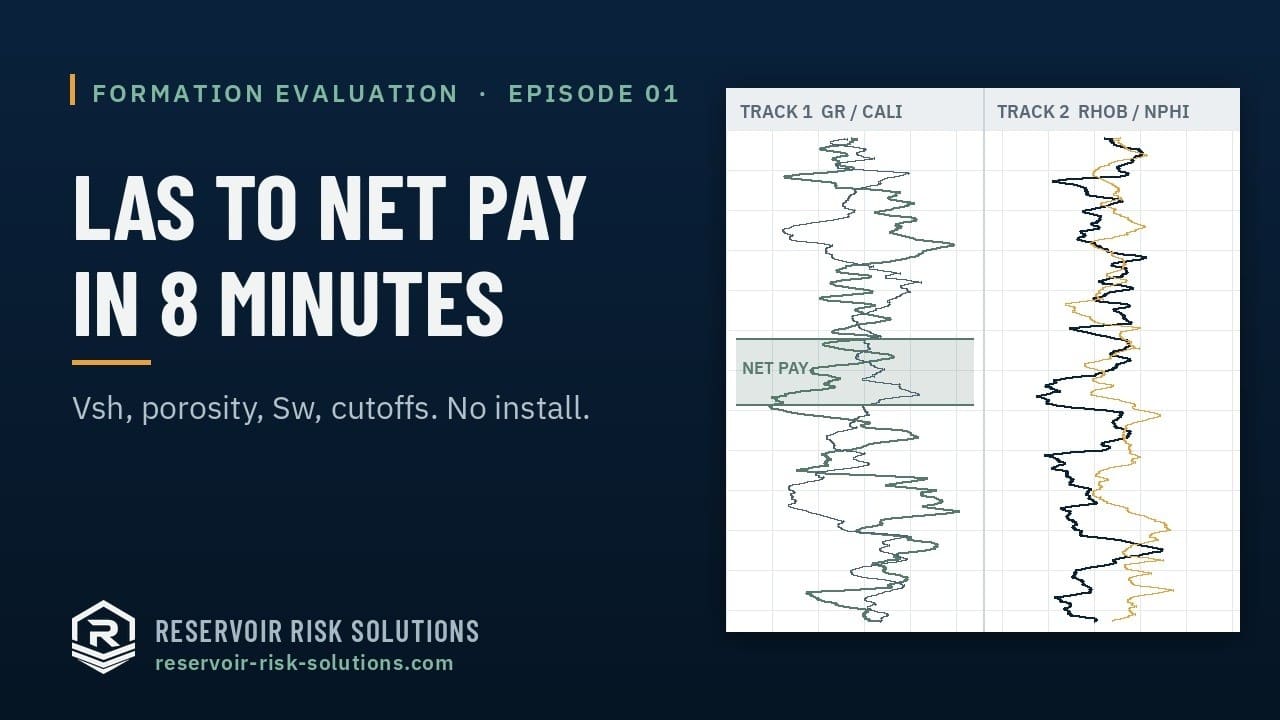
The same workflow in the software
Who it is for
Geoscientists, reservoir and production engineers, and graduates who need to read a standard log suite and build a first-pass interpretation they can defend.
Prerequisites: None beyond basic geology and algebra.
Take the module in the Learning Hub
Basic Petrophysics: Seven foundational modules with narrated lessons and chapter-based navigation. The lesson opens in the Learning Hub once the track is purchased; graded quizzes and the certificate come with the certified option.