
Can I use Volumetrics without doing petrophysics first?
Yes. Zone inputs can be staged from Formation Evaluation, imported from the CSV template, or typed in directly. Nothing upstream is required.
Volumetrics
Compute STOIIP or GIIP and recoverable volumes deterministically, then run Monte Carlo over the inputs you are genuinely unsure about, and see which of them is actually moving the answer.
Volumetrics takes zone averages staged from Formation Evaluation, or values you enter directly, and turns them into a volume with a distribution around it. Oil and gas project modes, Field and Metric display units, and every intermediate term visible rather than folded into a single number.
Volumetrics is included from the Starter plan, with Well Correlation and Formation Evaluation. See pricing
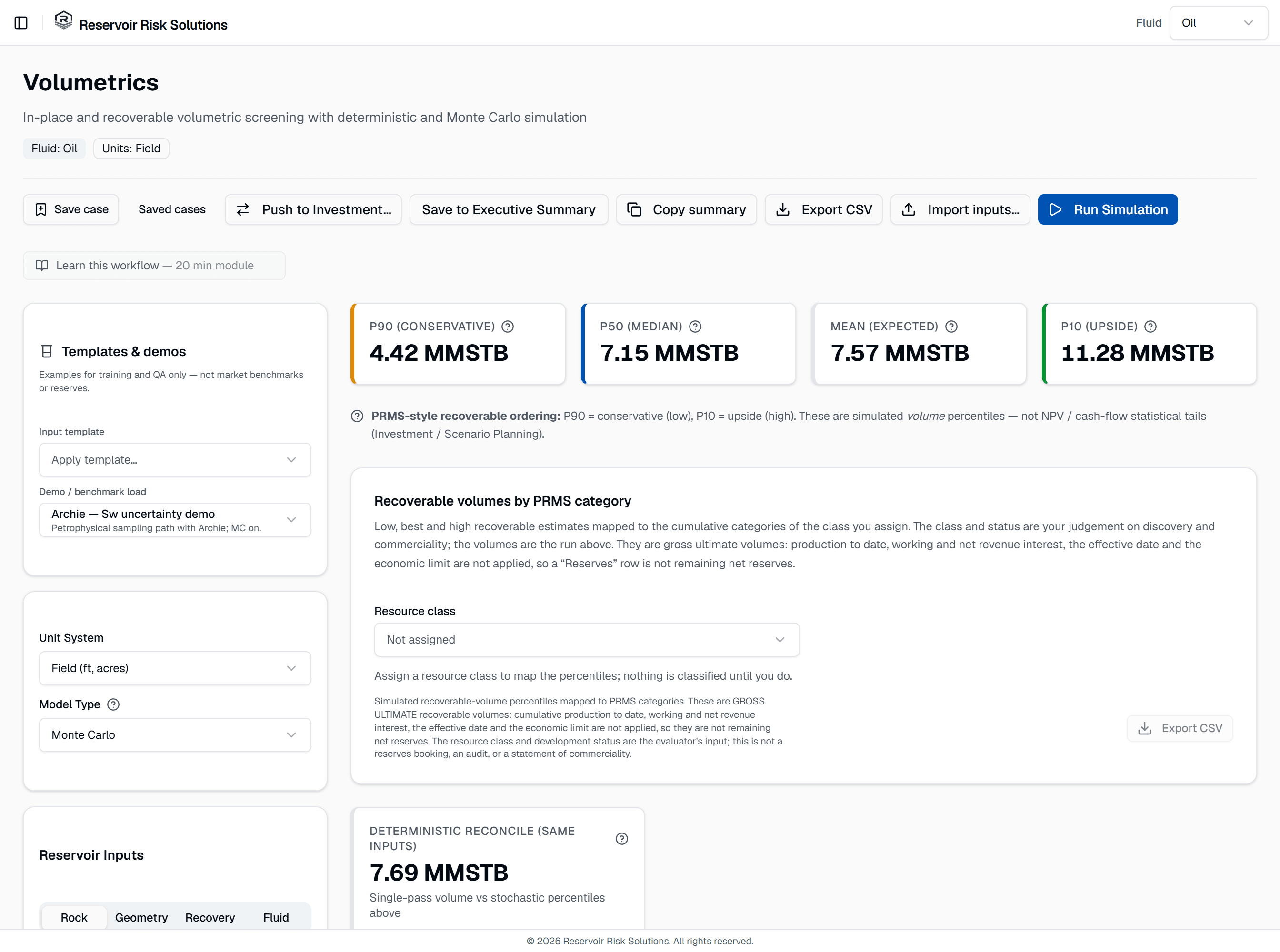
A single number is a starting point, not an answer. Both paths use the same engine and the same inputs:
A wide P90–P10 spread tells you there is uncertainty; it does not tell you where it comes from. Tornado sensitivity swings each input across its range and shows the effect on volume, so you can see whether the number is hostage to net-to-gross or barely notices it. Spearman rank correlation ranks the Monte Carlo drivers by how strongly each sampled input actually moved the output, which is the honest answer to "what should we go and measure next?"
Zone averages arrive from Formation Evaluation through an explicit in-browser bridge with a review step, so petrophysics and volumes cannot silently disagree. When the volume is settled, stage recoverable volumes forward into Investment the same way. You can also import headline inputs from a fixed CSV template, parsed in your browser with a preview before anything is applied; the file is never uploaded to our servers.
Yes. Zone inputs can be staged from Formation Evaluation, imported from the CSV template, or typed in directly. Nothing upstream is required.
Archie, Simandoux, Modified Simandoux, Indonesia, Waxman-Smits, Juhasz, plus a Manual option for entering Sw directly. Formation Evaluation carries an overlapping set of 7 model families for log-based interpretation.
They are percentiles of the simulated volume distribution: P90 is the low-side value that 90% of realisations exceed, P10 the high side. They describe the uncertainty you specified in the inputs. The workspace can map them onto PRMS-style categories once you assign the resource class, but that class is your judgement on discovery and commerciality; the table is not a booking and is not a substitute for your own reserves process.
No. CSV import is parsed in your browser against a downloadable template, with a preview before apply. The file itself is not stored on our servers.
Deterministic volumes, Monte Carlo, tornado sensitivity, and rank-correlation drivers in one workspace. Included from Starter.