Intermediate Petrophysics · Module I5
Pressure/Contact Consistency
Formation pressure data as the independent check on a log interpretation. The module covers what a wireline formation tester measures, fluid identification from pressure gradients, the difference between the free water level and the oil–water contact, transition zones, compartmentalisation, and how to turn contact uncertainty into low, mid and high cases.
- Level
- Intermediate
- Position
- Module 5 of 8
- Video
- About 20 minutes, narrated
- Format
- Narrated video lesson and slide reading view; with the certified option, a quiz whose pass unlocks the next module.
What the module covers
- What formation pressure tests measure
- Fluid gradients and the densities they imply
- Free water level versus oil–water contact
- Capillary transition zones and their log signature
- Diagnosing disagreement between logs and pressures
- Compartments, and low, mid and high contact cases
Learning outcomes
After the module you should be able to:
- Validate contact assumptions using pressure evidence.
- Fit fluid gradients and read contacts from their intersections
- Reconcile log-derived contacts with pressure evidence
- Build a contact range for the volumetric model
A short preview
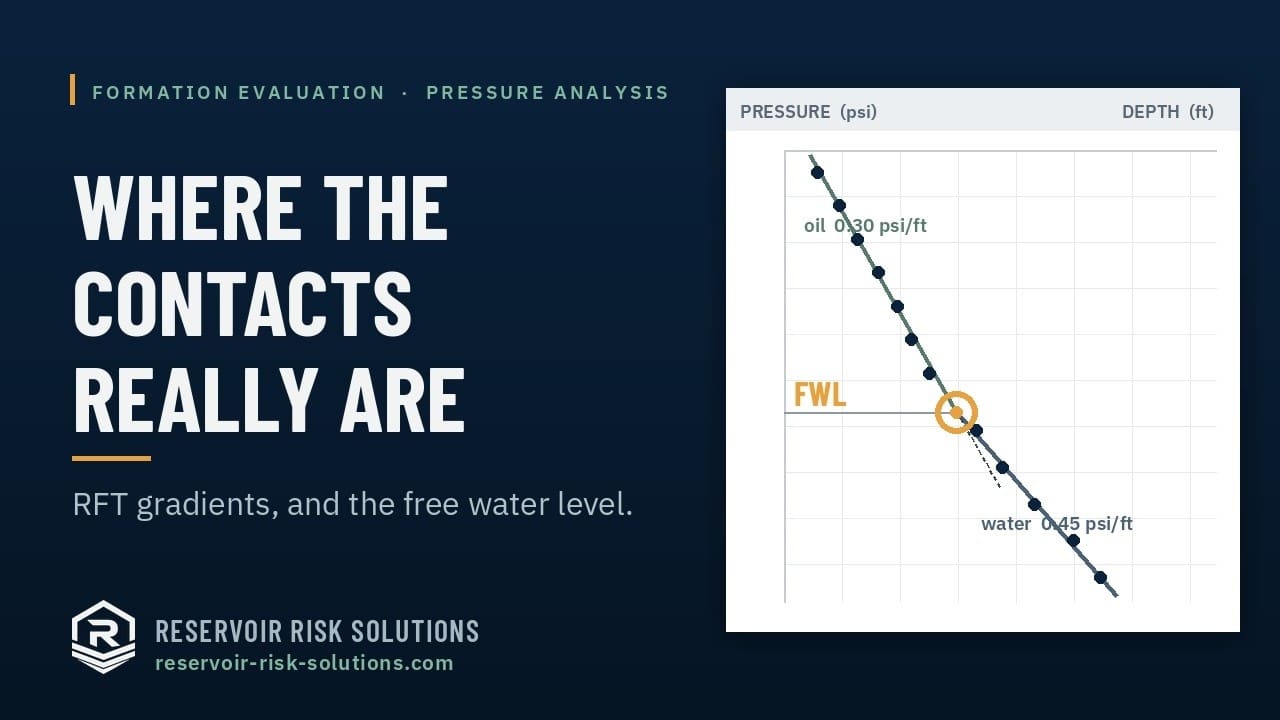
Pressure gradients identify fluids by density: water around 0.45 psi/ft, oil roughly 0.25 to 0.40, gas roughly 0.05 to 0.15. Where an oil line and a water line cross is the free water level, the depth at which capillary pressure is zero. The oil–water contact seen on the logs sits above it by the height needed to overcome the rock's entry pressure, a few feet in a good sand and much more in tight rock. Treating the two as the same depth puts an error straight into the rock volume.
The same workflow in the software
Who it is for
Petrophysicists and geoscientists with some interpretation experience, and engineers who review petrophysical inputs before they reach a volumetric or simulation model.
Prerequisites: The Basic Petrophysics track, or equivalent working experience.
Take the module in the Learning Hub
Intermediate Petrophysics: Eight applied modules with checkpoints; with the certified option, pass each quiz to unlock the next lesson. The lesson opens in the Learning Hub once the track is purchased; graded quizzes and the certificate come with the certified option.